


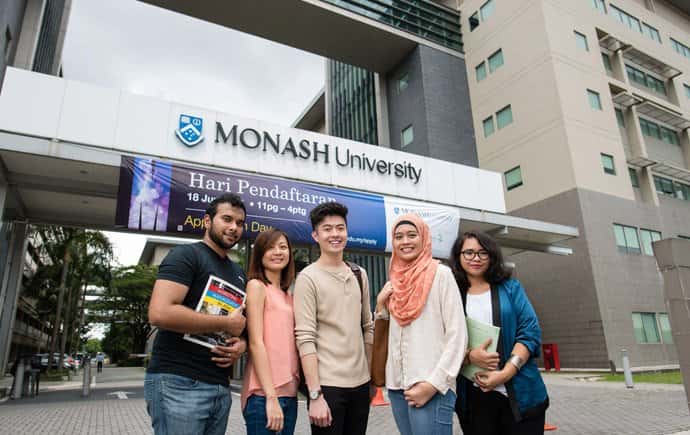

Monash University Malaysia — Complete International Student Guide 2026–2027
Verified summary
Established in 1998 as Malaysia’s first foreign university campus, Monash University Malaysia delivers Monash University awards in Bandar Sunway. The current catalogue covers pathways, undergraduate, coursework postgraduate and research degrees. Monash University is ranked 31st globally in the QS World University Rankings 2027.
2027 world ranking: 31. Source
Fee policy: Where entered, the programme tuition figure is the official 2026 annual international tuition in Malaysian ringgit, not the total degree cost. International students must also allow for 6% service tax from 1 July 2025, application, registration, amenities, visa, insurance and living costs.
Verification date: 31 August 2026.
How to use this guide
Treat this record as a decision aid, not as a substitute for the live university page or signed offer. Start with the exact programme title, level, mode, campus and intake. Open the recorded official source, save a dated copy and ask admissions to resolve every mismatch in writing. A programme can change curriculum, intake, fee, delivery mode or professional status between research and enrolment, so repeat the check immediately before applying and again before paying.
Admission planning
Build a calendar backwards from the intended intake. Allow time for eligibility review, certified translations, English testing, portfolio or interview work, financial approval, offer acceptance, visa processing, travel and accommodation. International applicants should not copy domestic deadlines because visa lead time changes the practical cut-off. Submit clear complete documents and keep the application number, named contact, date, version and written replies in one evidence folder.
Academic eligibility
The award title alone does not prove eligibility. Universities assess the type and level of prior qualification, grades, prerequisite subjects, institution status and sometimes recency or relevant experience. Ask for a written assessment against the exact country qualification. For credit transfer, provide module outlines and hours as well as transcripts. Never assume that an agent’s informal comparison commits the faculty or guarantees advanced standing.
English evidence
Confirm the accepted test, minimum overall score, component thresholds, validity period, waiver rules and whether a conditional language route exists. Professional programmes and postgraduate schools may apply higher requirements than the general university minimum. Match the name and passport details on the score report, arrange official delivery if requested and leave retake time. A visa requirement, university entry rule and professional registration rule can be separate tests.
Document checklist
Prepare a passport with sufficient validity, complete certificates and transcripts, grading scale, certified translations, English evidence, recent photograph and application declarations. Depending on the programme, add a portfolio, audition, interview evidence, CV, references, employment letters, research proposal, supervisor confirmation, health report or professional registration. Scan every page legibly, preserve original colour, use consistent names and explain any gap or spelling difference before review.
Fees and total cost
Separate tuition from registration, deposits, international administration, 6% SST where applicable, EMGS and visa charges, insurance, medical screening, laboratory or studio materials, professional examinations, fieldwork, travel, accommodation, utilities and daily living. Ask for a dated itemised schedule in Malaysian ringgit that states the fee basis, payment dates and what happens after a repeat, extension, thesis examination, deferment or withdrawal. Exchange-rate illustrations are not a guaranteed bill.
Safe payment
Pay only through a channel confirmed on the official university domain or in a verified invoice. Match the university name, applicant number, programme, intake and amount before transfer; never use a personal bank account. Keep the bank advice, portal receipt and written allocation confirmation. Read refund, visa-refusal, deferment and cancellation conditions before any non-refundable payment, including the evidence and time limit required for a claim.
Visa and EMGS
International students normally need a valid student pass managed through the university and Education Malaysia Global Services. Follow only current university and EMGS instructions for passport validity, offer documents, health declarations, insurance, personal bond, medical screening and arrival. Processing is not guaranteed by an admission offer. Do not book inflexible travel until the required approval is issued, and report passport renewal or travel changes promptly.
Accommodation
Compare university residence and private housing by total monthly cost, deposit, contract length, utilities, internet, furnishing, cooking, laundry, security, transport and early-arrival arrangements. Confirm the actual campus before signing because a university may teach programmes at different locations. Inspect the written inventory, photograph the room, understand deposit deductions and avoid paying an unverified owner. Budget for temporary housing if the visa or intake date shifts.
Living budget
Build a realistic monthly plan for rent, utilities, food, local transport, mobile data, study materials, health needs, personal care and emergencies. Add one-time arrival costs such as deposits, bedding, adapters and local travel. Test the budget under a weaker exchange rate and keep an emergency reserve outside routine spending. Student work rules are limited and can change, so do not rely on part-time income to fund essential tuition or living costs.
Academic fit
Read the curriculum rather than choosing by title. Compare core and elective modules, mathematics and coding depth, laboratory or studio work, projects, assessment balance, placement design, research exposure and final-year requirements. Ask which electives actually run, how large classes are and whether specialist facilities are available to undergraduates. Map each required skill for the intended career to evidence in the current module descriptions.
Accreditation and recognition
Check the Malaysian Qualifications Register using the exact award, institution, campus and delivery mode. Then contact the professional regulator, licensing authority or employer in the country where you intend to work. Academic accreditation does not automatically create a professional licence abroad. Medicine, dentistry, pharmacy, nursing, engineering, architecture, accounting, psychology and other regulated fields can require separate examinations, supervised practice or programme-specific recognition.
Research applicants
A broad research degree title is only a starting point. Define the problem, methods, data or laboratory needs, ethics, likely supervisor and expected outputs. Read recent staff publications and ask about meeting frequency, facilities, fieldwork, software, publication charges, intellectual property and progress milestones. Confirm whether tuition is annual, how extensions and thesis examination are charged and whether a supervisor’s interest constitutes formal admission.
Career preparation
Work backwards from the occupation and target country. Identify registration, language, software, portfolio, supervised hours, internship, examination and networking requirements, then test whether the programme can supply the evidence. Ask for current placement rules and graduate examples without treating them as guarantees. International graduates must separately check immigration and work authorisation; graduating does not create an automatic right to remain employed in Malaysia.
Student support
Ask about academic advising, library access, writing and statistics support, counselling, disability adjustments, health services, prayer spaces, clubs, sports, international-student orientation and emergency contacts. Confirm how to request help, what documentation is needed and whether services operate during semester breaks. Students managing a condition should discuss reasonable support early while preserving privacy and arrange medication, insurance and continuity of care before travel.
Scholarships and discounts
Treat scholarships as conditional until the university confirms eligibility, value, coverage, duration, acceptance deadline and renewal rules in writing. Check whether the award covers tuition only or also tax and other charges, whether it can be combined with another discount and what happens after a failed or repeated module, transfer, deferment or change of programme. Build the base budget without an unconfirmed award.
Academic integrity
Learn the university rules for citation, collaboration, examinations, data handling, laboratory records and permitted use of generative AI. A practice accepted in one education system may breach another institution’s policy. Keep drafts and sources, ask when collaboration is unclear and never buy assignments or alter documents. Misconduct can affect progression, visa status, professional suitability and future applications, not merely a single grade.
Health and safety
Complete required screening and disclose relevant conditions through the approved confidential route. Verify insurance coverage, exclusions, panel clinics, emergency procedure and medication rules. Save university security, local emergency and international-office contacts. Use registered transport, protect passports and financial details, follow laboratory and fieldwork training, and tell trusted contacts about travel. No university can remove all risk, so preparation and prompt reporting matter.
Deferral and withdrawal
Before accepting, ask how the university handles intake deferral, programme transfer, late arrival, visa delay, withdrawal, failed modules and medical interruption. Record deadlines, required forms and financial consequences. A deferral may require a new offer, fee adjustment or visa action and may not preserve a scholarship. Never assume verbal approval is complete; obtain the revised status and invoice through the official system.
Final decision audit
Create a one-page comparison covering exact award, curriculum, campus, mode, duration, verified tuition, total cost, accommodation, accreditation, foreign recognition, placement, career fit, visa timing, refund exposure and unanswered questions. Mark each item as confirmed, conditional or unknown and attach the source date. Do not pay while a material mismatch remains between the programme page, application, offer, invoice, MQA record or professional evidence.
Popular programmes to explore
This section highlights popular programmes only for easier comparison; the complete academic catalogue is kept in the separate programmes file.
| Programme | Level | Field | Duration | Tuition | Source |
|---|---|---|---|---|---|
| Bachelor of Business and Commerce | Bachelor | Business & Management | 3 years | RM 51,840 — published 2026 annual international tuition before tax and other charges | Official page |
| Bachelor in Actuarial Analytics | Bachelor | AI & Data | 3 years | RM 54,720 — published 2026 annual international tuition before tax and other charges | Official page |
| Bachelor of Robotics and Mechatronics Engineering (Honours) | Bachelor | Engineering | 4 years | RM 64,800 — published 2026 annual international tuition before tax and other charges | Official page |
| Bachelor of Software Engineering (Honours) | Bachelor | Computing & IT | 4 years | RM 64,800 — published 2026 annual international tuition before tax and other charges | Official page |
| Bachelor of Computer Science in Artificial Intelligence | Bachelor | AI & Data | 3 years | RM 54,720 — published 2026 annual international tuition before tax and other charges | Official page |
| Bachelor of Computer Science in Data Science | Bachelor | AI & Data | 3 years | RM 54,720 — published 2026 annual international tuition before tax and other charges | Official page |
| Bachelor of Medical Science and Doctor of Medicine | Doctorate | Medicine | 5 years | RM 138,720 — published 2026 annual international tuition before tax and other charges | Official page |
| Bachelor of Psychology | Bachelor | Psychology | 3 years | RM 49,920 — published 2026 annual international tuition before tax and other charges | Official page |
| Bachelor of Pharmacy (Honours) | Bachelor | Pharmacy | 4 years | RM 71,040 — published 2026 annual international tuition before tax and other charges | Official page |
| Bachelor of Pharmaceutical Science | Bachelor | Pharmacy | 3 years | RM 60,480 — published 2026 annual international tuition before tax and other charges | Official page |
| Bachelor of Applied Data Science | Bachelor | AI & Data | 3 years | RM 60,480 — published 2026 annual international tuition before tax and other charges | Official page |
| Master of International Business | Master | Business & Management | Confirm on the current official programme page | No stable total international figure verified; request a current itemised invoice | Official page |
| Master of Artificial Intelligence | Master | AI & Data | Confirm on the current official programme page | No stable total international figure verified; request a current itemised invoice | Official page |
| Master of Data Science | Master | AI & Data | Confirm on the current official programme page | No stable total international figure verified; request a current itemised invoice | Official page |
| Master of Clinical Psychology | Master | Medicine | Confirm on the current official programme page | No stable total international figure verified; request a current itemised invoice | Official page |
Decision guide for popular programmes
Bachelor of Business and Commerce
This is a bachelor programme in business & management at Monash University Malaysia. The direct evidence is the official programme page. Recorded duration: 3 years; tuition status: RM 51,840 — published 2026 annual international tuition before tax and other charges. Before applying, read the current curriculum and confirm campus, delivery mode, intake, English standard, prerequisite subjects, assessment, placement, project or thesis. Obtain a written eligibility decision and itemised international fee schedule rather than relying on a summary or verbal promise. Prepare the passport, certificates, transcripts, translations and English evidence, plus any portfolio, interview, CV, references, proposal or health document. Check MQA using the exact title, then ask the professional authority in the intended country about recognition and licensing; Malaysian accreditation does not guarantee an automatic foreign licence. Budget for tuition, tax, registration, visa, EMGS, insurance, housing, transport, materials and emergencies, and read refund and deferral rules before paying. Match the programme title across application, offer, invoice and visa records and pay only a verified university channel. Reopen the source when applying because price, intake, modules and professional status can change; the signed offer remains controlling.
Bachelor in Actuarial Analytics
This is a bachelor programme in ai & data at Monash University Malaysia. The direct evidence is the official programme page. Recorded duration: 3 years; tuition status: RM 54,720 — published 2026 annual international tuition before tax and other charges.
Bachelor of Robotics and Mechatronics Engineering (Honours)
This is a bachelor programme in engineering at Monash University Malaysia. The direct evidence is the official programme page. Recorded duration: 4 years; tuition status: RM 64,800 — published 2026 annual international tuition before tax and other charges.
Bachelor of Software Engineering (Honours)
This is a bachelor programme in computing & it at Monash University Malaysia. The direct evidence is the official programme page. Recorded duration: 4 years; tuition status: RM 64,800 — published 2026 annual international tuition before tax and other charges.
Bachelor of Computer Science in Artificial Intelligence
This is a bachelor programme in ai & data at Monash University Malaysia. The direct evidence is the official programme page. Recorded duration: 3 years; tuition status: RM 54,720 — published 2026 annual international tuition before tax and other charges.
Bachelor of Computer Science in Data Science
This is a bachelor programme in ai & data at Monash University Malaysia. The direct evidence is the official programme page. Recorded duration: 3 years; tuition status: RM 54,720 — published 2026 annual international tuition before tax and other charges.
Bachelor of Medical Science and Doctor of Medicine
This is a doctorate programme in medicine at Monash University Malaysia. The direct evidence is the official programme page. Recorded duration: 5 years; tuition status: RM 138,720 — published 2026 annual international tuition before tax and other charges.
Bachelor of Psychology
This is a bachelor programme in psychology at Monash University Malaysia. The direct evidence is the official programme page. Recorded duration: 3 years; tuition status: RM 49,920 — published 2026 annual international tuition before tax and other charges.
Bachelor of Pharmacy (Honours)
This is a bachelor programme in pharmacy at Monash University Malaysia. The direct evidence is the official programme page. Recorded duration: 4 years; tuition status: RM 71,040 — published 2026 annual international tuition before tax and other charges.
Bachelor of Pharmaceutical Science
This is a bachelor programme in pharmacy at Monash University Malaysia. The direct evidence is the official programme page. Recorded duration: 3 years; tuition status: RM 60,480 — published 2026 annual international tuition before tax and other charges.
Bachelor of Applied Data Science
This is a bachelor programme in ai & data at Monash University Malaysia. The direct evidence is the official programme page. Recorded duration: 3 years; tuition status: RM 60,480 — published 2026 annual international tuition before tax and other charges.
Master of International Business
This is a master programme in business & management at Monash University Malaysia. The direct evidence is the official programme page. Recorded duration: Confirm on the current official programme page; tuition status: No stable total international figure verified; request a current itemised invoice.
Master of Artificial Intelligence
This is a master programme in ai & data at Monash University Malaysia. The direct evidence is the official programme page.
Master of Data Science
This is a master programme in ai & data at Monash University Malaysia. The direct evidence is the official programme page.
Master of Clinical Psychology
This is a master programme in medicine at Monash University Malaysia. The direct evidence is the official programme page.
Before choosing a programme: How to use this guide
Treat this record as a decision aid, not as a substitute for the live university page or signed offer. Start with the exact programme title, level, mode, campus and intake. Open the recorded official source, save a dated copy and ask admissions to resolve every mismatch in writing. A programme can change curriculum, intake, fee, delivery mode or professional status between research and enrolment, so repeat the check immediately before applying and again before paying. Turn this information into an auditable action: record the question, answer, staff contact and source date, tied to the exact programme, intake and campus. Compare the reply with the live programme page, MQA record, offer and invoice; treat any unwritten discrepancy as unresolved. Keep a searchable copy and schedule a fresh check because fees, seats, modules, accreditation and visa procedures can change.
Before choosing a programme: Admission planning
Build a calendar backwards from the intended intake. Allow time for eligibility review, certified translations, English testing, portfolio or interview work, financial approval, offer acceptance, visa processing, travel and accommodation. International applicants should not copy domestic deadlines because visa lead time changes the practical cut-off. Submit clear complete documents and keep the application number, named contact, date, version and written replies in one evidence folder.
Before choosing a programme: Academic eligibility
The award title alone does not prove eligibility. Universities assess the type and level of prior qualification, grades, prerequisite subjects, institution status and sometimes recency or relevant experience. Ask for a written assessment against the exact country qualification. For credit transfer, provide module outlines and hours as well as transcripts. Never assume that an agent’s informal comparison commits the faculty or guarantees advanced standing.
Before choosing a programme: English evidence
Confirm the accepted test, minimum overall score, component thresholds, validity period, waiver rules and whether a conditional language route exists. Professional programmes and postgraduate schools may apply higher requirements than the general university minimum. Match the name and passport details on the score report, arrange official delivery if requested and leave retake time. A visa requirement, university entry rule and professional registration rule can be separate tests.
Before choosing a programme: Document checklist
Prepare a passport with sufficient validity, complete certificates and transcripts, grading scale, certified translations, English evidence, recent photograph and application declarations. Depending on the programme, add a portfolio, audition, interview evidence, CV, references, employment letters, research proposal, supervisor confirmation, health report or professional registration. Scan every page legibly, preserve original colour, use consistent names and explain any gap or spelling difference before review.
Before choosing a programme: Fees and total cost
Separate tuition from registration, deposits, international administration, 6% SST where applicable, EMGS and visa charges, insurance, medical screening, laboratory or studio materials, professional examinations, fieldwork, travel, accommodation, utilities and daily living. Ask for a dated itemised schedule in Malaysian ringgit that states the fee basis, payment dates and what happens after a repeat, extension, thesis examination, deferment or withdrawal. Exchange-rate illustrations are not a guaranteed bill.
Before choosing a programme: Safe payment
Pay only through a channel confirmed on the official university domain or in a verified invoice. Match the university name, applicant number, programme, intake and amount before transfer; never use a personal bank account. Keep the bank advice, portal receipt and written allocation confirmation. Read refund, visa-refusal, deferment and cancellation conditions before any non-refundable payment, including the evidence and time limit required for a claim.
Before choosing a programme: Visa and EMGS
International students normally need a valid student pass managed through the university and Education Malaysia Global Services. Follow only current university and EMGS instructions for passport validity, offer documents, health declarations, insurance, personal bond, medical screening and arrival. Processing is not guaranteed by an admission offer. Do not book inflexible travel until the required approval is issued, and report passport renewal or travel changes promptly.
Before choosing a programme: Accommodation
Compare university residence and private housing by total monthly cost, deposit, contract length, utilities, internet, furnishing, cooking, laundry, security, transport and early-arrival arrangements. Confirm the actual campus before signing because a university may teach programmes at different locations. Inspect the written inventory, photograph the room, understand deposit deductions and avoid paying an unverified owner. Budget for temporary housing if the visa or intake date shifts.
Before choosing a programme: Living budget
Build a realistic monthly plan for rent, utilities, food, local transport, mobile data, study materials, health needs, personal care and emergencies. Add one-time arrival costs such as deposits, bedding, adapters and local travel. Test the budget under a weaker exchange rate and keep an emergency reserve outside routine spending. Student work rules are limited and can change, so do not rely on part-time income to fund essential tuition or living costs.
Before choosing a programme: Academic fit
Read the curriculum rather than choosing by title. Compare core and elective modules, mathematics and coding depth, laboratory or studio work, projects, assessment balance, placement design, research exposure and final-year requirements. Ask which electives actually run, how large classes are and whether specialist facilities are available to undergraduates. Map each required skill for the intended career to evidence in the current module descriptions.
Before choosing a programme: Accreditation and recognition
Check the Malaysian Qualifications Register using the exact award, institution, campus and delivery mode. Then contact the professional regulator, licensing authority or employer in the country where you intend to work. Academic accreditation does not automatically create a professional licence abroad. Medicine, dentistry, pharmacy, nursing, engineering, architecture, accounting, psychology and other regulated fields can require separate examinations, supervised practice or programme-specific recognition.
Before choosing a programme: Research applicants
A broad research degree title is only a starting point. Define the problem, methods, data or laboratory needs, ethics, likely supervisor and expected outputs. Read recent staff publications and ask about meeting frequency, facilities, fieldwork, software, publication charges, intellectual property and progress milestones. Confirm whether tuition is annual, how extensions and thesis examination are charged and whether a supervisor’s interest constitutes formal admission.
Before choosing a programme: Career preparation
Work backwards from the occupation and target country. Identify registration, language, software, portfolio, supervised hours, internship, examination and networking requirements, then test whether the programme can supply the evidence. Ask for current placement rules and graduate examples without treating them as guarantees. International graduates must separately check immigration and work authorisation; graduating does not create an automatic right to remain employed in Malaysia.
Before choosing a programme: Student support
Ask about academic advising, library access, writing and statistics support, counselling, disability adjustments, health services, prayer spaces, clubs, sports, international-student orientation and emergency contacts. Confirm how to request help, what documentation is needed and whether services operate during semester breaks. Students managing a condition should discuss reasonable support early while preserving privacy and arrange medication, insurance and continuity of care before travel.
Before choosing a programme: Scholarships and discounts
Treat scholarships as conditional until the university confirms eligibility, value, coverage, duration, acceptance deadline and renewal rules in writing. Check whether the award covers tuition only or also tax and other charges, whether it can be combined with another discount and what happens after a failed or repeated module, transfer, deferment or change of programme. Build the base budget without an unconfirmed award.
Before choosing a programme: Academic integrity
Learn the university rules for citation, collaboration, examinations, data handling, laboratory records and permitted use of generative AI. A practice accepted in one education system may breach another institution’s policy. Keep drafts and sources, ask when collaboration is unclear and never buy assignments or alter documents. Misconduct can affect progression, visa status, professional suitability and future applications, not merely a single grade.
Before choosing a programme: Health and safety
Complete required screening and disclose relevant conditions through the approved confidential route. Verify insurance coverage, exclusions, panel clinics, emergency procedure and medication rules. Save university security, local emergency and international-office contacts. Use registered transport, protect passports and financial details, follow laboratory and fieldwork training, and tell trusted contacts about travel. No university can remove all risk, so preparation and prompt reporting matter.
Before choosing a programme: Deferral and withdrawal
Before accepting, ask how the university handles intake deferral, programme transfer, late arrival, visa delay, withdrawal, failed modules and medical interruption. Record deadlines, required forms and financial consequences. A deferral may require a new offer, fee adjustment or visa action and may not preserve a scholarship. Never assume verbal approval is complete; obtain the revised status and invoice through the official system.
Before choosing a programme: Final decision audit
Create a one-page comparison covering exact award, curriculum, campus, mode, duration, verified tuition, total cost, accommodation, accreditation, foreign recognition, placement, career fit, visa timing, refund exposure and unanswered questions. Mark each item as confirmed, conditional or unknown and attach the source date. Do not pay while a material mismatch remains between the programme page, application, offer, invoice, MQA record or professional evidence.
Before submitting the application: How to use this guide
Treat this record as a decision aid, not as a substitute for the live university page or signed offer. Start with the exact programme title, level, mode, campus and intake. Open the recorded official source, save a dated copy and ask admissions to resolve every mismatch in writing. A programme can change curriculum, intake, fee, delivery mode or professional status between research and enrolment, so repeat the check immediately before applying and again before paying.
Before submitting the application: Admission planning
Build a calendar backwards from the intended intake. Allow time for eligibility review, certified translations, English testing, portfolio or interview work, financial approval, offer acceptance, visa processing, travel and accommodation. International applicants should not copy domestic deadlines because visa lead time changes the practical cut-off. Submit clear complete documents and keep the application number, named contact, date, version and written replies in one evidence folder.
Before submitting the application: Academic eligibility
The award title alone does not prove eligibility. Universities assess the type and level of prior qualification, grades, prerequisite subjects, institution status and sometimes recency or relevant experience. Ask for a written assessment against the exact country qualification. For credit transfer, provide module outlines and hours as well as transcripts. Never assume that an agent’s informal comparison commits the faculty or guarantees advanced standing.
Before submitting the application: English evidence
Confirm the accepted test, minimum overall score, component thresholds, validity period, waiver rules and whether a conditional language route exists. Professional programmes and postgraduate schools may apply higher requirements than the general university minimum. Match the name and passport details on the score report, arrange official delivery if requested and leave retake time. A visa requirement, university entry rule and professional registration rule can be separate tests.
Before submitting the application: Document checklist
Prepare a passport with sufficient validity, complete certificates and transcripts, grading scale, certified translations, English evidence, recent photograph and application declarations. Depending on the programme, add a portfolio, audition, interview evidence, CV, references, employment letters, research proposal, supervisor confirmation, health report or professional registration. Scan every page legibly, preserve original colour, use consistent names and explain any gap or spelling difference before review.
Before submitting the application: Fees and total cost
Separate tuition from registration, deposits, international administration, 6% SST where applicable, EMGS and visa charges, insurance, medical screening, laboratory or studio materials, professional examinations, fieldwork, travel, accommodation, utilities and daily living. Ask for a dated itemised schedule in Malaysian ringgit that states the fee basis, payment dates and what happens after a repeat, extension, thesis examination, deferment or withdrawal. Exchange-rate illustrations are not a guaranteed bill.
Before submitting the application: Safe payment
Pay only through a channel confirmed on the official university domain or in a verified invoice. Match the university name, applicant number, programme, intake and amount before transfer; never use a personal bank account. Keep the bank advice, portal receipt and written allocation confirmation. Read refund, visa-refusal, deferment and cancellation conditions before any non-refundable payment, including the evidence and time limit required for a claim.
Core official sources
- https://www.monash.edu.my/
- https://www.monash.edu.my/intake
- https://www.monash.edu.my/study/apply
- https://www.monash.edu/news/articles/monash-achieves-highest-ever-position-in-qs-world-university-rankings-2027
- https://www.monash.edu.my/study/undergraduate/fees
- https://www.monash.edu.my/about/contact
- https://www2.mqa.gov.my/mqr/english/eakrKPList.cfm?IDAkrIPTS=150
- https://www.monash.edu.my/study/apply/intake-periods
This file reflects verification completed on 31 August 2026. Recheck the direct page and offer letter when applying.